
Introduction
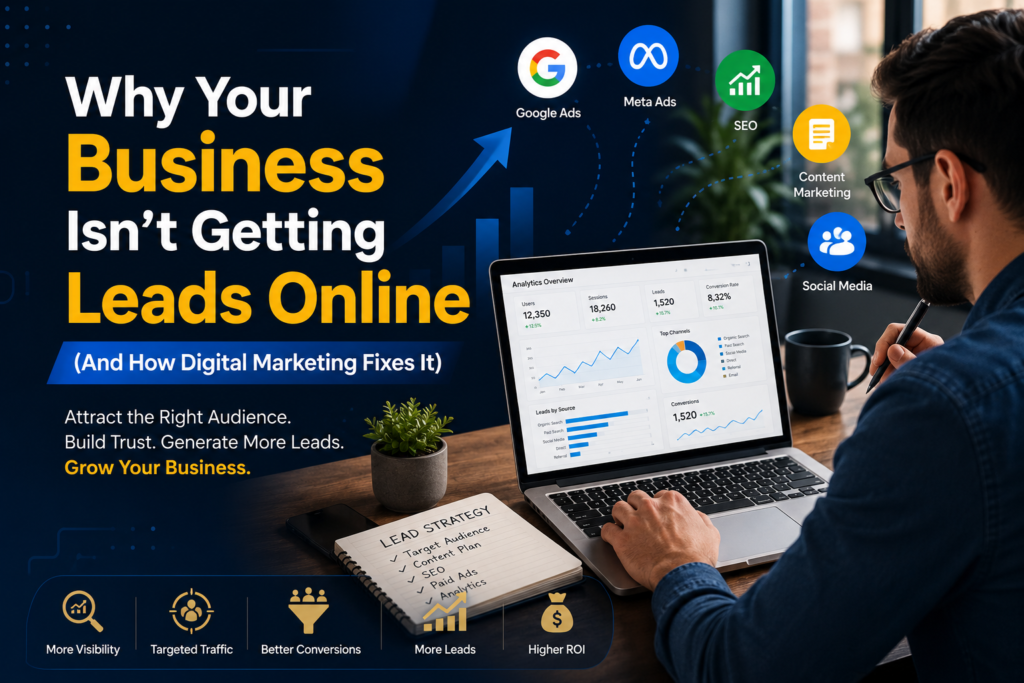
Many businesses invest in a website expecting it to generate inquiries, sales, and customers automatically. However, simply having a website doesn’t guarantee results. If your business isn’t receiving enough leads online, there are usually several underlying issues preventing potential customers from finding and engaging with your brand.
In this article, we’ll explore the most common reasons businesses struggle to generate leads and how digital marketing can help turn things around.
Not sure which platform is right for your business? Read Google Ads vs Facebook Ads: Which One is Best?
1. Your Website Has Low Visibility
If customers can’t find your business online, they can’t contact you.
Millions of searches happen on Google every day, and most users click on results appearing on the first page. Without proper optimization, your website may remain invisible to potential customers.
Solution
Search Engine Optimization (SEO) helps improve your website’s rankings by optimizing content, keywords, page speed, user experience, and technical performance. Better rankings mean more visibility, more traffic, and more opportunities to generate leads.
2. You’re Reaching the Wrong Audience
Not all website visitors are potential customers.
Many businesses spend money on advertising without clearly identifying their target audience. This often results in irrelevant traffic and poor conversion rates.
Solution
Successful digital marketing starts with understanding your ideal customer. By targeting the right audience through Google Ads, Meta Ads, and content marketing, businesses can attract visitors who are genuinely interested in their products or services.
3. Your Website Doesn’t Encourage Action
A website should do more than provide information—it should guide visitors toward taking action.
Common issues include:
- Weak call-to-action buttons
- Slow loading times
- Poor mobile responsiveness
- Complicated navigation
- Lack of trust signals
Solution
Create a user-friendly experience with clear contact forms, strong calls-to-action, testimonials, and easy navigation. Small improvements can significantly increase lead generation.
4. You’re Not Using Paid Advertising
Organic growth is valuable, but it often takes time.
Businesses looking for faster results should consider paid advertising platforms such as Google Ads and Meta Ads.
Benefits of Paid Advertising
- Immediate visibility
- Precise audience targeting
- Measurable results
- Scalable lead generation
- Improved brand awareness
A well-managed advertising campaign can help businesses reach potential customers exactly when they are searching for relevant products or services.
5. Your Content Isn’t Building Trust
Modern consumers research before making purchasing decisions. Businesses that provide useful information often earn more trust and credibility.
Effective Content Types
- Blog articles
- Industry guides
- Case studies
- Social media content
- Video marketing
- Email newsletters
Consistent content marketing positions your business as an authority in your industry and helps convert visitors into customers.
6. You’re Not Tracking Performance
Many businesses make marketing decisions based on assumptions rather than data.
Without tracking tools, it’s difficult to know:
- Which campaigns generate leads
- Which pages perform best
- Where visitors come from
- How users interact with your website
Solution
Use tools such as Google Analytics, Google Search Console, and conversion tracking to measure performance and improve marketing strategies over time.
Why a Complete Digital Marketing Strategy Matters
Successful lead generation requires multiple channels working together.
A comprehensive strategy often includes:
- Search Engine Optimization (SEO)
- Google Ads
- Meta Ads
- Social Media Marketing
- Content Marketing
- Website Optimization
- Analytics and Reporting
When combined effectively, these channels create a strong online presence that consistently attracts and converts potential customers.
Conclusion
If your business isn’t generating enough leads online, the issue is rarely the website alone. Low visibility, poor targeting, weak conversion strategies, and inconsistent marketing efforts often play a major role.
By implementing SEO, paid advertising, content marketing, and data-driven optimization, businesses can improve their online presence and generate a steady flow of qualified leads.
Digital marketing is no longer optional for businesses that want to grow—it is an essential investment for long-term success.
If you want to learn how to generate quality leads using digital marketing, explore the Digital Marketing Courses in Borivali.